
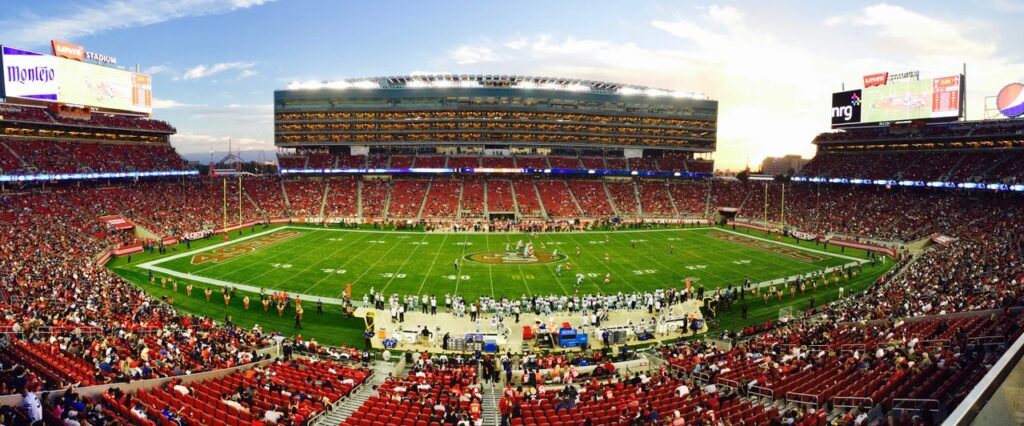
Every year, as the Super Bowl approaches, one of the first stories you’ll hear has nothing to do with the two teams competing for a championship. Instead, the headlines focus on the city hosting the game and the enormous economic impact expected from welcoming the NFL’s biggest event.
Host committees, chambers of commerce, and local officials often tout impressive numbers. Hundreds of thousands of visitors. Thousands of temporary jobs. Hundreds of millions—or even more than a billion dollars—in economic activity.
It’s an enticing sales pitch.
If your city lands the Super Bowl, you’re led to believe the game will provide an economic boost that pays dividends long after the Lombardi Trophy has been awarded.
But is that really what happens?
Or is the economic impact of the Super Bowl another example of a headline that deserves a closer look?
The Numbers Cities Love to Promote
The promotional studies released before a Super Bowl are almost always optimistic.
Leading up to Super Bowl LX in the San Francisco Bay Area, one host committee projected the event would generate between $370 million and $630 million in earnings, driven largely by more than 90,000 visitors traveling from outside the region.
When New Orleans prepared to host the 2025 Super Bowl, estimates suggested the game would generate approximately $1.25 billion in total economic output, including nearly $395 million in worker earnings and almost 10,000 jobs.
California officials projected approximately $500 million in regional economic activity for Super Bowl LX.
These aren’t insignificant figures. They become part of the marketing campaign cities use when competing for future events.
If these projections are accurate, the decision to spend millions preparing for the Super Bowl appears almost automatic.
Who wouldn’t invest in an event that promises such extraordinary returns?
The Other Side of the Story
Economists who study major sporting events often paint a much different picture.
One of the most frequently cited studies comes from economists Robert Baade and Victor Matheson. Their paper, appropriately titled Padding Required, examined whether host cities actually experienced stronger economic growth after hosting the Super Bowl.
Rather than relying on visitor surveys or spending estimates, they compared actual personal income growth in host cities with statistical models predicting what those cities should have experienced without the game.
Their findings surprised many people.
On average, host cities generated approximately $133 million less personal income than the statistical models predicted they would have produced had they not hosted the Super Bowl.
That doesn’t necessarily mean the Super Bowl hurts an economy.
It does suggest, however, that the enormous economic windfalls frequently advertised before the game may not materialize in practice.
So why is there such a dramatic difference?
Gross Spending Isn’t the Same as New Spending
Imagine your hometown normally attracts thousands of tourists during the first week of February.
Now imagine many of those visitors decide not to come because hotel prices have doubled, downtown streets are closed, and restaurants are packed with Super Bowl visitors.
The city may still report impressive spending numbers during Super Bowl week.
But how much of that spending is actually new?
Economists call this crowding out.
Super Bowl visitors often replace people who would have visited anyway rather than adding entirely new economic activity.
Business travelers postpone conferences.
Families choose another vacation destination.
Local residents avoid downtown restaurants because parking is impossible.
Hotels may still be full, but the guests occupying those rooms are simply different guests.
The gross spending numbers look impressive, yet the net increase is much smaller.
Not Every Dollar Stays in the Community
Another challenge is something economists call leakage.
When promotional studies estimate hundreds of millions in spending, it’s easy to assume that money remains in the local economy.
In reality, much of it doesn’t.
National hotel chains send profits back to corporate headquarters.
Large restaurant franchises distribute revenue beyond the local market.
National vendors supply merchandise.
Temporary workers often come from outside the region.
And, of course, the NFL itself retains a significant share of the revenue generated by the event.
The local economy certainly benefits from some of this spending.
But every dollar spent during Super Bowl week does not remain in the host city.
That’s an important distinction that promotional studies don’t always emphasize.
Security Isn’t Free
The Super Bowl is one of the largest security operations conducted for any annual sporting event in the United States.
Thousands of police officers.
Federal agencies.
Emergency medical personnel.
Traffic control.
Road closures.
Public transportation adjustments.
Crowd management.
These expenses can total tens of millions of dollars.
Some costs are reimbursed through state or federal assistance.
Many others fall directly on local governments.
Those expenditures rarely receive the same attention as the headline proclaiming “$500 Million Economic Impact.”
Yet they represent real taxpayer dollars.
To understand whether hosting the Super Bowl is worthwhile, those costs have to be included in the equation.
Infrastructure Costs Add Up
Security isn’t the only expense.
Host cities frequently invest in improvements before welcoming the Super Bowl.
Road repairs.
Beautification projects.
Transit upgrades.
Temporary event spaces.
Additional staffing.
Technology enhancements.
Some of these investments would likely occur eventually regardless of the Super Bowl.
Others are accelerated specifically because of the event.
Either way, they represent money that could have been allocated elsewhere.
The question isn’t simply how much money comes into the city.
It’s whether enough additional money comes in to justify everything spent preparing for the event.
Why Promotional Studies and Academic Studies Differ
One reason the debate continues is that the two sides often measure different things.
Promotional studies generally estimate economic activity.
They total visitor spending, hotel revenue, restaurant sales, transportation, entertainment, and apply economic multipliers to estimate how that spending circulates through the regional economy.
Independent economists tend to ask a different question.
What actually changed?
Would these restaurants have been busy anyway?
Would hotels have filled during that week regardless?
Did business simply shift from one neighborhood to another?
Did local residents delay spending because downtown became difficult to access?
Those questions attempt to measure net new economic activity, not simply gross spending.
That distinction explains why independent estimates are often much smaller than promotional projections.
Does Every Business Benefit?
It’s easy to assume every business enjoys a great week during the Super Bowl.
Many certainly do.
Hotels near the stadium often sell out.
Upscale restaurants may be booked months in advance.
Transportation companies can experience record demand.
Bars and entertainment venues frequently thrive.
But other businesses experience the opposite.
A neighborhood restaurant located outside the event zone may lose regular customers.
Retail stores may see fewer local shoppers.
Office buildings may operate remotely.
Some residents simply stay home to avoid traffic and crowds.
The economic benefits are often concentrated rather than evenly distributed.
That’s another nuance often missing from promotional headlines.
Are There Benefits Beyond Dollars?
To be fair, not every benefit should be measured strictly in financial terms.
Hosting the Super Bowl places a city on an international stage.
Millions of viewers see aerial shots, landmarks, waterfronts, and downtown skylines.
Local volunteers participate in community events.
Cities often gain experience hosting future conventions or major sporting events.
Civic pride can also be real.
Residents enjoy showcasing their city.
Community organizations benefit from volunteer opportunities.
Young athletes may become inspired by the experience.
These benefits are difficult to measure with economic statistics.
Whether they justify the investment depends largely on what a community values.
So, Is It Worth It?
The answer probably depends on what question you’re asking.
If the question is:
Does hosting the Super Bowl generate economic activity?
The answer is almost certainly yes.
Hotels fill.
Restaurants become busy.
Visitors spend money.
Temporary jobs are created.
But if the question becomes:
Does the city actually receive the enormous financial windfall promoted before the event once security costs, infrastructure spending, crowding out, and revenue leakage are considered?
The answer appears far less certain.
Independent research has consistently suggested that the net economic benefit is substantially smaller than the figures often highlighted in promotional campaigns.
Some studies even suggest host-city economies perform no better—or occasionally worse—than statistical expectations once all factors are considered.
The Bigger Question
Perhaps the more interesting question isn’t whether the Super Bowl creates economic activity.
Of course it does.
The better question is whether cities continue pursuing the event primarily because of economics.
Maybe the real value lies elsewhere.
Prestige.
International exposure.
Political visibility.
Tourism marketing.
Community pride.
Those are legitimate goals.
But they are different from promising taxpayers that hosting the Super Bowl will generate a billion-dollar economic payoff.
As sports fans, we hear impressive numbers every February.
As citizens, we should ask what those numbers actually measure.
Because sometimes the biggest story surrounding the Super Bowl isn’t played on the field at all.
It’s found in the assumptions behind the economic projections—and whether those projections hold up once the final whistle blows.